
Quick answer
What weapon categories are in RuneScape: Dragonwilds?
Three damage types, eight families. Melee splits into one-handed weapons (dagger, mace, sword, scimitar) and two-handed weapons (greatsword, warhammer, greataxe). Ranged splits into shortbows, longbows and crossbows. Magic splits into wands and battlestaves, which spend runes as ammunition. Each family is crafted and repaired at its own station — the crafting table, the blacksmith’s bench, the fletching bench or the mystic forge.
- Weapons are not all craftable from the menu: monsters and chests drop recipe items that must be read first, and several of the strongest recipes come from quests rather than from drops.
- Progression is gated by materials more than by levels. Vault Shards appear from the iron tier onward, Infernal Fragments at the mithril tier, and desert materials at the adamant tier.
- The wiki routes anyone wanting a damage-per-second comparison to its separate stamina and combat articles, so this page lists what is published and ranks nothing.
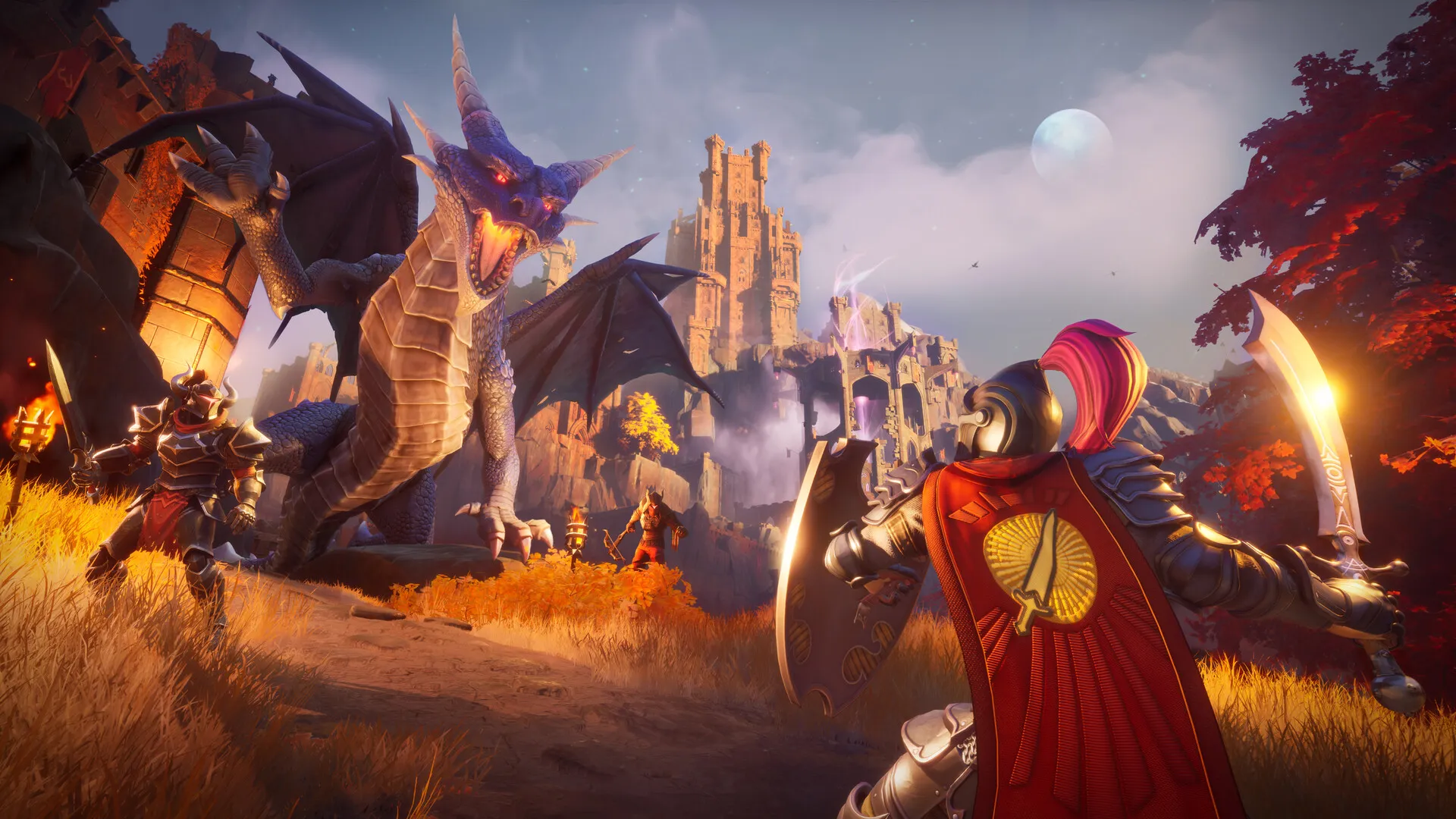
Four stations, three damage types, eight families
The wiki sorts weapons by damage type first and by family second, and the family is what decides which bench you stand at.
Every weapon in the game is made at one of four stations: the crafting table, the blacksmith’s bench, the fletching bench or the mystic forge. The same stations repair a weapon when its durability drops or it breaks, so the bench that built a weapon is also the bench that maintains it. Recipes are only half shop-bought knowledge — monsters and chests drop recipe items that have to be read before the weapon becomes craftable, and a number of the better recipes come out of a named quest instead.
| Damage type | Families | Bench | Notes |
|---|---|---|---|
| Melee | One-handed: dagger, mace, sword, scimitar. Two-handed: greatsword, warhammer, greataxe. | Crafting table for the early tiers, blacksmith’s bench once metal bars are involved. | One-handed weapons have a matching shield to pair with, or the off-hand can stay free. Two-handed weapons cannot use a shield but can still block. |
| Ranged | Shortbows, longbows, crossbows. | Fletching bench. | Bows are wood-first and limb-second: each tier wants a log from that region plus thread, a bar and a gem. Crossbows need manufactured limbs. |
| Magic | Wands and battlestaves. | Mystic forge, with the cheapest battlestaff crafted at a crafting table. | Runes are the ammunition, so a magic weapon carries a second resource cost that the other two types do not have. |
Family split and stations from the wiki weapons article; the blacksmith’s bench and crafting table split follows the crafted-via line on each weapon entry.
Melee: blunt or slashing, one hand or two
The melee ladder is the longest in the game and the only one that publishes a full damage range for every step.
Melee weapons deal blunt or slashing damage, and that split matters more than it first looks. A video guide published in July 2026 recommends not obsessing over it, but notes it is worth swapping a sword for a hammer in a zone full of skeletons or knights, because those are weak to blunt. The same video dislikes the hammer for general use — its special attack mostly stuns and the weapon is slow — and prefers either a one-handed mace with a shield or a two-handed sword, on the grounds that both stun-lock low-level enemies.
| Tier | Material family | One-handed example | Damage | Weight |
|---|---|---|---|---|
| 1 | Stone | Stone dagger / Stone club | 7 - 18 / 14 - 24 | 13 |
| 2 | Bone | Bone dagger / Bone club | 14 - 35 / 26 - 46 | 16.5 |
| 3 | Bronze | Bronze dagger / Bronze mace | 20 - 51 / 38 - 68 | 19.5 |
| 4 | Iron | Iron dagger / Iron mace | 29 - 74 / 56 - 99 | 23 |
| 5 | Steel | Steel dagger / Steel mace | 38 - 98 / 73 - 130 | 26 |
| 6 | Mithril | Mithril dagger / Mithril mace | 48 - 123 / 92 - 164 | 30 |
| 7 | Adamant | Adamant dagger / Adamant mace | 59 - 152 / 114 - 202 | 30 |
Damage ranges and weights as published on the wiki. Maces sit at the top of each one-handed tier; scimitars sit between maces and swords and trade damage for their Leaping Slash special.
Two-handed melee climbs faster than one-handed at every tier. The adamant greataxe is listed at 168 - 294, the adamant warhammer at 156 - 244 and the adamant greatsword at 129 - 219, against 114 - 202 for the adamant mace — at the cost of a heavier weapon and no shield hand. The same video calls the greatsword its own favourite for general play, while being explicit that this is a preference rather than a test result.
| Special attack | Seen on | What the wiki says |
|---|---|---|
| Lacerate | Daggers, including the dragonbone and wolfbane daggers | The dagger-line special, listed on every dagger entry from stone upward. |
| Block Breaker | Maces and clubs | The mace-line special, from the stone club through to the adamant mace. |
| Barge | Swords | The sword-line special, from the wooden training sword to the adamant sword. |
| Leaping Slash | Scimitars | The scimitar-line special, from the steel scimitar to the adamant scimitar. |
| Whirlwind Slash / Quake / Decimate | Two-handed greataxes, warhammers and greatswords | The three two-handed specials, one per family, carried consistently up the tiers. |
| Battering Ram | Granite maul | Special attack on a weapon assembled from an imbued head, an ornate handle and imbued leather wrappings, with its recipe learned from the quest Granite Mauled. |
| Flames of Rage | Titan’s Wrath | The special on a greatsword rebuilt from a Broken Titan’s Wrath plus black metal, blue dragon leather and mystics. |
Special attack names and the weapons carrying them are taken from the wiki weapon tables, which print the special attack beside each entry.
Ranged: three bow families that disagree about distance
Ranged is the category where the wiki draws the sharpest distinctions, because each family has a different relationship with range and fire rate.
Shortbows work at close and moderate range and do the least damage per shot, but they can be quick-fired for a faster rate at reduced range and damage. Longbows must be drawn, which gives them the lowest fire rate and the highest range and per-shot damage of the three. Crossbows are the only one-handed ranged weapons: they cannot be drawn at all, firing instantly and reloading automatically, with a reload that is delayed if you try to fire during it. They do moderate damage at the shortest range of the family.
| Tier | Wood | Shortbow | Longbow | Crossbow |
|---|---|---|---|---|
| 2 | Ash | Ash shortbow, 13 | Adventurer’s longbow, 23 | — |
| 3 | Oak | Oak shortbow, 20 | Oak longbow, 34 | Bronze crossbow, 25 |
| 4 | Blightwood | Blightwood shortbow, 29 | Blightwood longbow, 49 | Blurite and iron crossbows, both 37 |
| 5 | Willow | Willow shortbow, 38 | Willow longbow, 65 | Steel crossbow, 49 |
| 6 | Maple | Maple shortbow, 48 | Maple longbow, 82 | Mithril crossbow, 61 |
| 7 | Yew | Yew shortbow, 58 | Yew longbow, 100 | Adamant crossbow, 75 |
| 8 | Magic | Magic Shortbow, 78 | Magic Longbow, 118 | Rune crossbow, 88 |
Damage as published on the wiki. The wiki lists no materials for the magic-tier bow and the rune crossbow yet, so treat the top of each ladder as unverified rather than as a shopping list.
One named crossbow breaks its own tier
The Dorgeshuun crossbow is listed at 97 damage on tier 5, well above the steel crossbow’s 49 at the same tier and higher than the adamant crossbow’s 75. It fires bone bolts, and its recipe comes from completing Even More Restless Ghosts, which is the likely explanation for the jump — a quest reward parked in the middle of a material ladder.
Ranged weapons also carry the widest spread of special effects in the catalogue. The Wild scout’s shortbow and the Hunter stagbow both reduce draw time, with the stagbow also carrying a +10% draw time penalty listed against the same line. The Undead ranger’s bow adds damage at the cost of durability, the Shadow crossbow trades fire rate for weak point damage, the Blurite crossbow speeds up reloading while cutting durability by a quarter, and Ulv’s Longbow and the Crystal bow add damage against unaware targets and drop the arrow requirement from their special action respectively.
Magic: wands for pace, battlestaves for the big cast
Magic is the only category the wiki publishes as damage per second rather than as a damage range, and it says why.
The wiki magic section states that its damage-per-second figures assume a full magic armour set bonus and include the magical critical chance and casting perks — meaning the numbers in that table are a geared caster rather than a naked one. Wands are described as trading rune damage multipliers for mobility and speed. Battlestaves get a secondary attack that spends five runes per cast, with the effect changing by rune: air stuns and knocks back, scaling with charge time; fire breathes a cone that gains duration rather than damage, at two to five ticks; water damages everything around you and then leaves a healing field that restores allies standing in it.
That water behaviour is worth flagging, because a separate video guide published in July 2026 lists healing through water magic as one of the reasons to run a melee character with a casting style alongside it. Two independent sources describing the same utility is about as close as this page gets to a recommendation.
| Tier | Wand, damage per second | Battlestaff, damage per second |
|---|---|---|
| 2 | — | Ash battlestaff, 1.9 |
| 4 | Oak Wand, 2.8 | Oak battlestaff, 2.8; Blightwood and Draconic staves, 4.1; Staff of light, 4.5 |
| 5 | Blightwood Wand, 4.1; Splitbark Wand, 5.4 | Splitbark staff, 5.4; Necromancer’s staff, 5.9 |
| 6 | Maple Wand, 6.8 | Maple battlestaff, Subjugation staff and Zamorak staff, all 6.8 |
| 7 | Master Wand, 8.3 | Master’s staff, Pharaoh’s sceptre and Toktz-mej-tal, all 8.4 |
| 8 | Ancestral Wand, 9.8 | Ancestral Staff, 9.8 |
The wiki prints one figure per casting weapon in this section and states that it assumes a full magic set bonus, so these are geared figures rather than a naked comparison.
How progression actually gates a weapon
Levels are the smaller half of the story. Materials, vaults and quests are the larger half.
Read down a weapon ladder and the materials change in a predictable order. The first four tiers ask for logs, thread, animal parts and metal bars. From the iron tier onward every metal weapon also wants Vault Shards, which come out of the vaults. The mithril tier swaps in Cursed Leather, Mystic Thread and Infernal Fragments, and the top tier wants Scorch Leather, Desert Thread, Dragonstones and Gypsum Wax — desert materials, which is a location gate rather than a level gate.
| Added in | What the wiki records |
|---|---|
| 0.12.0, 22 June 2026 | Power Level 7 weapons were added to the game. |
| 0.11, 31 March 2026 | Power Level 6 weapons were added to the game. |
| 0.10, 15 December 2025 | Power Level 5 weapons were added to the game. |
| 0.9, 11 September 2025 | Crossbows and bolts were added to the game. |
| 0.8.2, 29 July 2025 | Fixed an issue where players were stuck in position when equipping a bow. |
Update history as published on the wiki weapons article. The top three entries line up with the steel, mithril and adamant tiers appearing as each new region shipped.
The other gate is knowledge. Recipes are learned from items — an educational blade on a church roof in Temple Woods teaches the wooden training sword; a dragonkin statue in the Fractured Plains vault teaches the Wild scout’s shortbow; a string of sinew taken from garou hunters teaches the Hunter stagbow. Others come from quests: the Crystal bow from Heartstrings, Ulv’s Longbow from Mirror, Mirror, the Bow of Elidinis from Mapping The Sands II, the Staff of light from Highlighting the Problem, the Zamorak staff from What’s Theirs is Mine!, the Pharaoh’s sceptre from Contact!, and the Granite maul from Granite Mauled.
- Weapon buffs sit outside the weapon. The July video names four — whetstones, weapon barbs, weapon poison and fire oil — all unlocked through separate skill tracks rather than crafted onto the weapon permanently.
- Special actions arrive with the weapon. The attack combo strings printed on the wiki include the bonus attacks from Weapon Expertise, which unlocks at 16 Attack, so a weapon reaches full combo length only after that point.
The weapons that will earn their own page
A weapon deserves a page of its own when it stops being one item and starts being a hunt.
Most weapons on this page are a tier, a damage figure and a list of materials, and a table is the right home for them. A handful are not, because assembling them is a project with steps of its own. Those are the ones this site will split out first: the Granite maul, which needs an imbued head, an ornate handle and imbued leather wrappings plus a vault core; Titan’s Wrath, which is a rebuild that starts from a Broken Titan’s Wrath; Imaru’s talon, which consumes a steel scimitar and an undead draconic visage; and the magic-tier shortbow, longbow and rune crossbow, whose material lists the wiki has not published at all yet.
Until then, the honest reading of this catalogue is that it tells you what exists and what it costs, and does not tell you what wins. That is covered next on the armour guide for what you wear with all of this, and on the builds guide for how a weapon choice turns into a play pattern.
Sources
What this page was checked against.
- RuneScape: Dragonwilds Wiki — Weapons
- RuneScape: Dragonwilds Wiki — Armour
- Game Advisor — RuneScape: Dragonwilds Melee Attack Guide
How this page was verified
Written on 16 September 2026 from the wiki weapons and armour articles and one video guide published on 12 July 2026. No weapon was crafted and no damage figure was tested for this page. Damage, weight and material values are quoted as the wiki publishes them, the update history is quoted from the changelog list on the same article, and the one opinion about the strongest weapon is labelled as an opinion rather than reproduced as a conclusion.
Still open
- The magic-tier shortbow, longbow and rune crossbow have no material lists on the wiki, and the Magic Shortbow row also has no weight listed. The top of both ranged ladders is therefore a damage figure without a recipe.
- The wiki columns after the damage figure are not labelled in the cached copy, so this page reports the tier, damage, weight, materials and special attack — all of which are self-evident from the entries — and leaves the unlabelled per-category constant alone.
- No damage-per-second comparison was made between melee, ranged and magic. The wiki keeps those figures in separate stamina and combat articles that were not read for this page, and the melee opinion quoted here comes from one channel rather than from testing.
- Several weapons carry effects the wiki itself flags as uncertain, including a source-needed note on the Zamorak staff’s burning damage and a bug note that makes a shortbow damage value read 0 in game.
- Whether 1.0 rebalanced weapon damage is unknown here. The cached weapons article carries an update history only up to 0.12.0, so any rebalance shipped on 15 September 2026 would not appear in it.